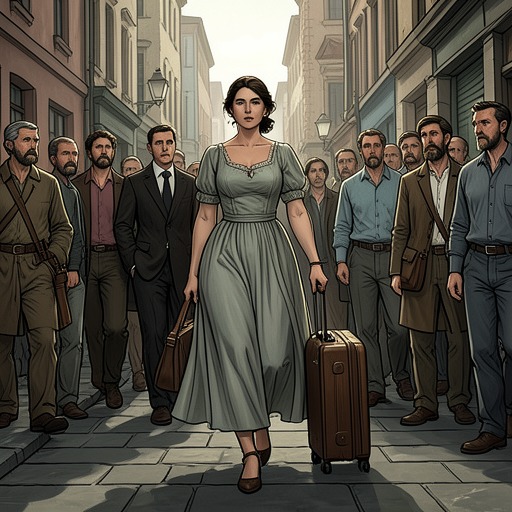
Trixie Beaumont
It Must Be Love: A Mustang Prairie RomanceTrixie Beaumont, formerly Beatrice Robinson, is the central figure of a transformation from an overlooked girl with an unrequited attachment into an independent entrepreneur, designer, mentor, and emotionally self-protective adult. Her return to Mustang Prairie reconnects her with Jack Thorpe and his family, but the decisive movement of her story is not simply romantic: it is the conversion of private imagination into a functioning lingerie business and, finally, a launched brand that gives her a life on her own terms.
Identity and Background
Trixie is the grown version of the awkward red-haired Beatrice Robinson whom Jack Thorpe remembers from the neighborhood. Jack’s recognition comes only after he has encountered her as the confident owner of Under the Skirt; the revelation that she is the childhood girl who once lived next door exposes the distance between her remembered, disregarded self and the woman she has deliberately made. As a child, she watched Jack from afar while he devoted his attention to Marissa Thorpe, leaving her with a private history of longing that he never understood.
Her family background gives her both practical independence and emotional uncertainty. Her parents, Peri Moon and Toro Moon, are described as gifted providers, farmers, academics, hippies, and perpetual travelers, but they are not emotionally present in the way Trixie needs. While they travel through South America in a new RV, Trixie faces the risks of building a career without dependable parental encouragement. Her former marriage was another source of pressure: away from the oppressive discouragement of her ex-husband and his family, she can finally treat her own ambitions as legitimate rather than excessive.
Creative and Entrepreneurial Trajectory
Under the Skirt is the first visible structure of Trixie’s independence. She takes pleasure in the shop’s quietest hour, when the shelves are filled with lingerie and she can imagine replacing the existing stock with designs of her own: garments for women in sexy cuts, vivid colors, and varied styles. The dream is initially tentative. She buys sketchpads, experiments with names and logo ideas, and even contacts a graphic designer, yet the unfinished materials become reminders that she has not acted. Her decision to visit the interim mayor at Mustang Prairie City Hall marks the point at which an idea begins to require public approval and practical commitment.
Her first line takes a concrete form as Sexy Separates by Trixie. She envisions six to ten styles of panties, ranging from g-strings to bikini, French-cut, and possibly boy-cut designs, using silk, lace, and cotton. Four bra styles, including a convertible option, would allow customers to mix and match rather than depend on traditional matching sets. A rainbow theme provides the collection with a visual principle, while Sadie’s habit of combining different colors confirms Trixie’s belief that customers should be able to construct their own combinations. The concept joins commercial flexibility to a philosophy of choice: lingerie need not enforce one authorized version of femininity.
Trixie’s business decisions are cautious as well as imaginative. Under the Skirt Online officially opens after several consecutive profitable months, and she considers renting the neighboring space as both warehouse and design workspace. She even imagines hiring a part-time employee earlier than her business plan predicted. At the same time, she refuses to surrender quality control while the line is new. When Jonquil Spring suggests reconsidering the interview process and using a manufacturer, Trixie explains that she wants total control over the work until the brand is established. She may later contract manufacturing, but only after the line has proved its standards and identity.
The launch converts private labor into a communal spectacle. At Dylan’s bar, a makeshift runway divides the room while Sadie and the other models present Trixie’s designs to music by Sadie and Kiki Ramirez. The setting is transformed by lights, draped gauze, music, and lingerie into a playful bedroom-like space. Trixie watches a teal ensemble, a white bra and cheeky combination with a silky duster, and cherry-red stilettos receive the attention she hoped would establish the line. Cameras flash, the room applauds, and the models congratulate her backstage. The show is successful and the brand is officially launched, but the triumph contains a quiet absence: Trixie has achieved the milestone and still feels that she has no one, not really, with whom to share it.
Mentorship, Family, and Community
Trixie’s shop is not merely a retail setting. Abby Thorpe begins visiting almost every day around three, first asking about fabric and stitching and then revealing herself as a budding designer. Trixie recognizes the girl’s talent, gives her fabric containing silver that she knows Abby will love, and teaches her how to tie off the shrug so that it curves properly. She also instructs Abby to use enough yarn for the garment to fall at the correct point. The exchange establishes Trixie as a patient mentor whose creative knowledge is offered generously rather than guarded as proprietary advantage.
Her connection with Jack Thorpe’s children develops with striking ease. Although the girls have not warmed to women other than their mother since Marissa Thorpe’s death, they treat Trixie as if she has always belonged in their lives. During Thanksgiving, Jack’s parents, Sadie, Dylan, Luna, Mr. Scanlan, Jonquil, Abby, and Andie gather in Jack’s house, while Trixie arrives only ten minutes before the meal, having deliberately avoided prolonged contact with Jack. Even while she distances herself from him, she remains connected to the household through the children and through the wider Mustang Prairie community.
Jonquil’s arrival gives Trixie a different kind of family relationship. When the exceptionally intelligent child identifies Trixie as her half-sister, Trixie learns that she is the daughter of Peri Moon and Toro Moon and that Jonquil was born after Trixie left for college. Trixie responds by helping Jonquil become more comfortable in her surroundings and by committing herself to giving her a semi-normal life. At the workshop, Trixie also includes Jonquil in the practical work of building the brand, allowing her to rank seamstresses and participate in decisions while retaining final authority. Jonquil’s presence makes Trixie smile more often and turns the business into a site of sisterly collaboration.
That care extends into ordinary acts of recognition. For Jonquil’s first Christmas, Trixie buys her a red leather jacket and helps assemble an outfit of grey skinny jeans, an Einstein T-shirt, and black motorcycle boots. Jonquil’s uncertainty about whether the outfit is truly right for her is answered by Trixie’s immediate affirmation. The scene shows Trixie using clothing not to impose an identity but to help another person inhabit one with confidence.
Desire, Conflict, and Emotional Boundaries
Trixie’s attraction to Jack is shaped by an old imbalance: she once loved him from a distance, while he barely noticed her and chose Marissa. When they reconnect as adults, physical desire becomes mutual, but emotional expectations do not. Trixie eventually tells Jack directly that she is attracted to him and that this attraction is a problem. Her admission is an act of emotional honesty, yet it also signals that she understands the danger of allowing desire to dictate the terms of her future.
After sleeping with Jack, Trixie recognizes that the experience was intensely pleasurable but incompatible with what she ultimately wants. Jack offers no promise because his life is already full of fatherhood, painting, and family obligations, while Trixie wants the possibility of love and lifelong commitment. She therefore adopts distance as a deliberate survival strategy. Her repeated avoidance of Jack, including her late arrival at Thanksgiving, is not indifference; it is an attempt to prevent a noncommittal sexual relationship from becoming a renewed version of her childhood longing.
Trixie explains the boundary to Sadie in unequivocal terms. She and Jack have hooked up several times, but he remains in love with his wife and does not want anything serious. Trixie refuses to compete with a ghost, even though she is not demanding marriage immediately. What she insists upon is the option of a serious future. Her independence is therefore emotional as well as economic: she does not believe that a man is necessary for sexual fulfillment, and she will not exchange her prospects for temporary intimacy with someone who has already declared himself unavailable.
Jack’s family sees the conflict from another angle. Jack’s mother tells him that Trixie had once followed the happy couple from a safe distance, like a little ghost, and suggests that he tell Trixie the truth about his marriage. She identifies the tension, anger, and resentment surrounding his relationship with Marissa and warns that Trixie is being forced to compete with an absent woman. Jack’s daughters, Abby and Andie, likewise understand more than he expects. Abby tells him that apologizing is what boys should do after hurting girls’ feelings and urges him to apologize to Trixie because both sisters know he likes her. Trixie’s relationship with Jack thus becomes a family matter even while she tries to keep it from determining her life.
Change and Narrative Significance
Trixie’s defining change is the movement from imagined possibility to material achievement. At first, her future line exists in sketchpads, tentative names, and logos that reproach her for inaction. Later, it has a coherent product philosophy, an online business, a production strategy, models, marketing plans, and a public fashion show. Her design work gives shape to a self that was once diminished by an ex-husband, overlooked by Jack, and left without reliable emotional support from her parents.
Her clothing also becomes a language of self-presentation. In one encounter she appears in rainbow hair, while at dinner with Jack she chooses a white tank with a red bra beneath it, black leather pants, knee-high boots, and a black leather jacket. These garments express confidence and deliberate sensuality, but they do not erase her nervousness or uncertainty. Trixie’s performance of boldness coexists with careful calculation, business discipline, and the need to protect a vulnerable emotional history.
By the launch of Sexy Separates by Trixie, she has secured a form of belonging that does not depend on being chosen by Jack Thorpe. She is valued by Abby and Andie, loved by Jonquil, supported by friends and collaborators, and recognized through the work she has made. The romantic relationship remains unresolved in the supplied material, but Trixie’s trajectory is already decisive: she no longer waits for an old wish to come true before allowing her own life to begin. Her deepest achievement is not simply the success of a lingerie line. It is the creation of a home, a vocation, and a public identity capable of holding desire without surrendering to it.